MCC 7995 Explained
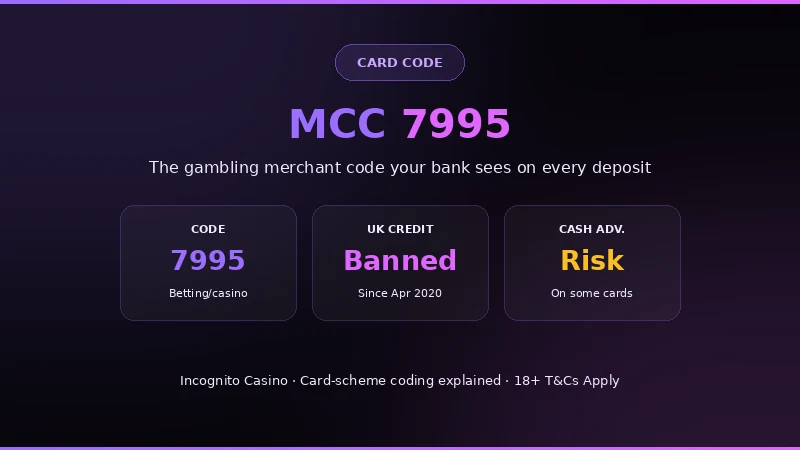
Four digits decide whether your casino deposit goes through, costs you cash-advance interest, or gets refused before it reaches the operator. Here is what MCC 7995 is, who assigns it, and what UK banks do with it.
What MCC 7995 actually is
A merchant category code is a four-digit label the card schemes attach to a business so that everyone downstream knows what kind of company took the payment. Supermarkets have one. Airlines have one. And gambling has 7995, defined by Visa and Mastercard as betting, including lottery tickets, casino gaming chips, off-track betting and wagers.
The code is not assigned by a gambling regulator and it is not chosen by the casino. It is set by the acquiring bank — the payment processor that signs the merchant up — and it travels with every authorisation request the merchant sends. Your bank receives it, reads it in milliseconds, and applies whatever rules it holds for that category before deciding to approve or decline.
This is why the code matters far more than most players realise. Your issuer has no idea whether you spun a slot, backed a horse or bought a lottery ticket. It knows one thing: the merchant is coded 7995. Every consequence on this page — blocks, cash-advance treatment, declines, gambling-spend summaries in your banking app — flows from that single field.
The journey of one deposit
- You enter your card details at the casino cashier and press deposit.
- The casino’s payment provider builds an authorisation request stamped with MCC 7995 and the merchant’s country.
- The card scheme routes it to your issuing bank.
- Your bank checks the code against your account rules: gambling block on or off, card type, spend limits, fraud model.
- Approve or decline comes back in under a second. The casino sees only “declined” — it is not told why, which is why support cannot tell you either.
What it means for a UK player
Four consequences, and they compound.
1. Credit cards are effectively closed off
Since 14 April 2020 the Gambling Commission has barred GB-licensed operators from accepting credit cards, including credit-funded e-wallet payments. An offshore site sits outside that rule, but your issuer does not: most UK banks treat a 7995 authorisation on a credit card as a cash advance. That means interest from day one, no interest-free window, and a handling fee of roughly 3% with a minimum charge. A GBP 100 deposit can cost several pounds before a single spin.
2. Gambling blocks read this field, not the site name
Every UK bank gambling block — Monzo, Starling, Barclays, Lloyds, HSBC, NatWest, Nationwide, Revolut and the rest — works by refusing merchant category codes, not by maintaining a list of casino websites. Switch it on and 7995 is declined at authorisation, before the operator is ever involved. The operator genuinely cannot override it.
3. Your bank can measure gambling spend
Because the code is machine-readable, banking apps that show “you spent X on gambling this month” are simply summing 7995. The same data is visible to a lender reading your statements during a mortgage or loan affordability assessment. The transaction is not on your credit file, but it is on the statement a lender may ask to see.
4. Fraud models treat it as high risk
A gambling merchant abroad, on a card that has never touched one, is a textbook fraud signal. Plenty of first deposits are declined for this reason alone and go through on the second attempt after the bank’s app asks you to confirm the transaction was yours.
At Incognito specifically there is a second layer on top: the wallet is euro-denominated, so a UK card deposit is both a gambling transaction and a foreign-currency one. Some issuers price those separately, which is how a GBP 50 deposit turns into GBP 51.60 on the statement. The full arithmetic sits on our Incognito verdict page.
Timeline: how gambling card payments got here
The code is created
Visa and Mastercard formalise MCC 7995 as part of the standard merchant category list. It is an accounting and risk-pricing device long before anyone uses it for consumer protection.
Issuers start pricing it as cash
UK card issuers increasingly classify gambling merchant codes as cash-equivalent transactions, applying cash-advance fees and immediate interest on credit cards.
Bank gambling blocks arrive
Starling, Monzo, Barclays and others launch app-level gambling blocks that refuse gambling merchant codes, most with a mandatory cooling-off delay before the block can be removed.
UK credit-card ban takes effect
The Gambling Commission bars GB-licensed operators from accepting credit cards, covering e-wallet deposits funded by credit card. Debit cards are unaffected.
Blocks become near-universal
Gambling blocks spread across essentially every UK current-account provider, and gambling-spend summaries appear as a standard feature in banking apps.
Sharper focus on offshore merchants
With more UK traffic reaching non-GB-licensed sites, issuers tighten fraud rules around foreign gambling merchants. First-deposit declines at offshore casinos become noticeably more common than at GB-licensed ones.
7995 and the codes around it
A gambling block that covers only 7995 leaves gaps. This is the family of codes a thorough block should refuse.
| Code | Covers | Typical UK use |
|---|---|---|
| 7995 | Betting, casino gaming chips, off-track betting, wagers | Online casinos and bookmakers, including offshore sites such as Incognito |
| 7800 | Government-owned lotteries | National lottery products |
| 7801 | Government-licensed online casinos and gambling | Some regulated online casino operators |
| 7802 | Government-licensed horse and dog racing | Licensed racing operators |
| 9754 | Horse and dog racing, non-US | Racecourse and racing-specific merchants |
If you are using a bank block as a harm-reduction tool, check in your app which codes it covers. And treat it as one layer only: a block on the card does not stop a bank transfer, a crypto purchase or a wallet top-up.
Your deposit was declined — what to do
Work through these in order. The first two account for most cases.
Check whether a gambling block is on
Open your banking app and look under card controls or security. If a gambling block is active, that is your answer. Lifting it involves a deliberate cooling-off period, commonly 48 to 72 hours, and neither the casino nor we can shorten it.
Check what card you used
A credit card is the second most common cause. Many UK issuers refuse gambling merchants on credit outright, and the ones that allow it charge cash-advance interest and a fee. Use a debit card.
Look for a confirmation prompt
Fraud systems often hold a first gambling transaction pending your confirmation. Approving it in the app and retrying once usually works. Retrying five times in a row does not, and can lock the card.
Confirm the details match
Name, billing address and postcode on the card must match your casino profile. A mismatch produces a decline that looks identical to a block.
Consider that it is the merchant, not you
Acquirers occasionally drop a gambling merchant, or an operator’s processor has an outage. If a different card also fails within minutes, the problem is upstream and waiting is the only fix.
If the block was deliberate, leave it alone
A gambling block you turned on yourself is doing exactly what you asked it to. The cooling-off delay exists because the moment you most want it gone is the moment it is most useful. Free, independent support: BeGambleAware (0808 8020 133), GamCare, and GAMSTOP for self-exclusion across GB-licensed sites. Note that GAMSTOP does not reach offshore operators, so a bank block is the layer that does.
Before and after the 2020 rule change
| Item | Before April 2020 | Now |
|---|---|---|
| Credit cards at GB-licensed sites | Accepted | Prohibited by the Gambling Commission |
| Credit-funded e-wallets | A common workaround | Caught by the same prohibition |
| Bank gambling blocks | Offered by a handful of challengers | Standard across UK current accounts |
| Cooling-off before lifting a block | Rare | Usual, commonly 48–72 hours |
| Offshore sites and credit cards | Accepted | Often still accepted by the site, but treated as a cash advance by your issuer |
| Gambling spend visibility | Manual to work out | Summarised automatically in banking apps |
Sources
- UK Gambling Commission — the licence condition prohibiting credit-card gambling at GB-licensed operators, in force from 14 April 2020.
- BeGambleAware — guidance on bank blocks and other practical spending controls.
- GamCare — free support, including help setting up blocking tools.
- Card-scheme merchant category code definitions as published by Visa and Mastercard for category 7995.
- Cash-advance treatment and fee structures as set out in individual UK issuers’ published credit-card terms — these vary by issuer, so check yours.
Checked 6 September 2026. Issuer policies change; the code itself does not.
Frequently asked questions
What is MCC 7995?
Why was my card declined at an online casino?
Is MCC 7995 treated as a cash advance?
Can I turn off a gambling block on my bank card?
Does MCC 7995 apply to offshore casinos too?
Which merchant codes do gambling blocks cover?
Will a gambling transaction show on my credit file?
Keep reading

Written and fact-checked by Philip Newall, Senior Lecturer in Experimental Psychology, University of Bristol. Last verified 6 September 2026 · updated 5 September 2026.